 en
en  Italian

- 13/07/2026
- Technological materials
Index
-
Article description
- Mare Nostrum by Abet Laminati turns the Mediterranean into a decorative surface
- The six patterns of the collection reinterpret nature and marine biodiversity
- Re-Abet enhances decorative laminates with post-consumer recycled kraft paper
- SurfInBench brings the Mare Nostrum collection to Ostuni Design Weekend 2026
- The decorative laminate becomes a tool for narrative design
- Mare Nostrum expands the applications of decorative laminates in architecture and interior design
- Abet Laminati confirms its ongoing research in surface design
- Fill the contact form
Decorative surfaces are now called upon to play an increasingly important role in interior design. In addition to ensuring technical quality and durability over time, they become tools capable of expressing an identity, evoking landscapes and conveying values through textures, colors and materials.
With the Mare Nostrum collection, Abet Laminati interprets this evolution by offering a series of decorative laminates that turn the Mediterranean into a visual story made of patterns, rhythm and material. The project, signed by Matteo Ragni, stems from the desire to represent the sea not only as a natural element, but as a shared cultural heritage, a place of biodiversity, encounter and exchange.
Each surface translates this vision into a contemporary graphic that enhances the expressive potential of HPL laminate, demonstrating how surface design can become a means to communicate environmental and cultural themes without sacrificing the requirements of architecture and interior design.
Mare Nostrum by Abet Laminati turns the Mediterranean into a decorative surface
With Mare Nostrum, Abet Laminati develops a collection in which the surface becomes a tool for narrative design.
The inspiration comes from the Mediterranean Sea, understood as an ecosystem rich in biodiversity but also as a common heritage to be preserved. This concept is translated into a series of decorative laminates that interpret natural elements through essential geometries and contemporary graphic signs.
The result is a collection in which the material does not only serve an aesthetic function, but tells a story, turning the cladding into an integral part of the interior design project.
From this perspective, the surface assumes a new design value, becoming an element capable of communicating cultural and environmental content through the language of design.
The six patterns of the collection reinterpret nature and marine biodiversity
The expressive strength of Mare Nostrum lies in the six patterns that make up the collection, each inspired by a different aspect of the sea.
Fetch reproduces the movement of waves generated by the wind through a rhythmic, continuous texture. Papersail evokes the relationship between wind and sailing, while Islands reworks nautical charts and sea depths through concentric geometries.
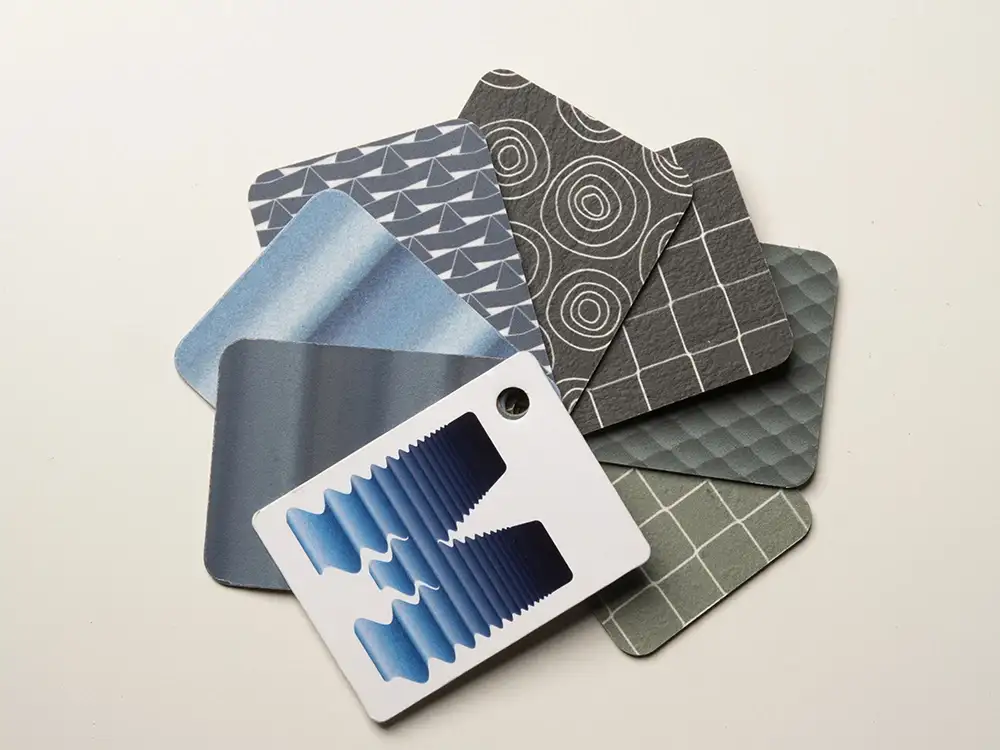
The collection also includes Net, which transforms fishing nets into a graphic grid, Octopus, inspired by the suction cups of the octopus and characterized by an organic language, and Shark, which interprets the distinctive structure of shark skin through innovative material effects.
Each decoration stems from the intention to transform natural elements into decorative textures capable of dialoguing with architecture, furnishings and contemporary design, expanding the application possibilities of HPL laminate.
Re-Abet enhances decorative laminates with post-consumer recycled kraft paper
The design research of Mare Nostrum does not concern only the aesthetic language of the surface, but also involves the choice of material.
The entire collection is in fact produced in Re-Abet, a decorative laminate made with a component of 100% post-consumer recycled kraft paper, developed to reduce the use of virgin raw materials and promote more responsible design.
This choice reinforces the collection's message, creating coherence between content and material: a surface that tells the story of the sea is realized through a solution that concretely testifies to Abet Laminati's commitment to sustainability, the circular economy and production innovation.
In this way, the decorative laminate becomes not only a high-performance cladding, but also a tool through which surface design contributes to a project culture that is increasingly aware.
SurfInBench brings the Mare Nostrum collection to Ostuni Design Weekend 2026
To showcase the collection's potential, Abet Laminati presents SurfInBench, a site-specific installation created by Matteo Ragni for the Ostuni Design Weekend 2026.
The installation interprets the silhouette of a surfboard by transforming it into a bench designed for resting, meeting and contemplation. The object, supported by an essential structure and connected by two ropes that evoke the movement of waves, is intended to dialogue with open spaces and the Mediterranean landscape.
More than a simple urban accessory, SurfInBench becomes a concrete demonstration of how decorative laminate can also be applied in outdoor contexts, maintaining aesthetic quality, functionality and durability.
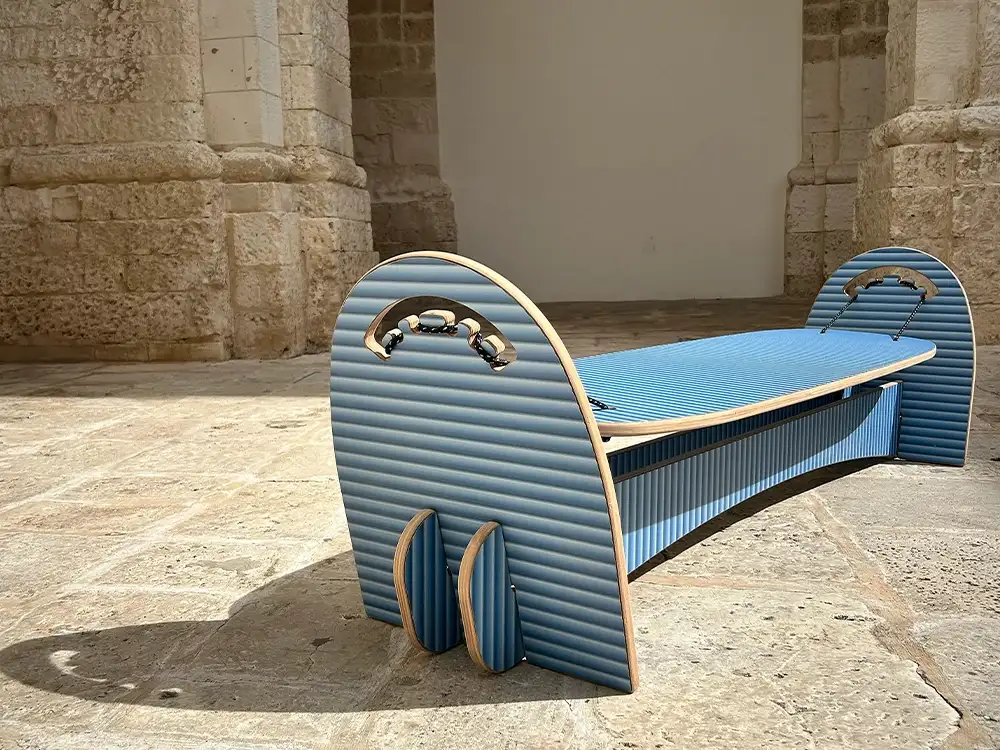
The seat surface is clad with Fetch, one of the collection's patterns, which translates the movement of the sea into a continuous graphic texture, confirming the ability of the surface to become an integral part of the project.
The decorative laminate becomes a tool for narrative design
With Mare Nostrum, Abet Laminati offers a vision of HPL laminate that goes beyond the mere role of cladding.
The collection's surfaces do not simply characterize spaces aesthetically, but introduce a narrative content that accompanies the architecture and interior design project.
Waves, currents, marine fauna and nautical charts are reinterpreted through a contemporary graphic language that turns each pattern into a visual story. The result is a collection capable of dialoguing with materials, furnishings and spaces, helping to define the identity of the environment through the surface.
This approach highlights one of the main evolutions of contemporary surface design: the surface no longer represents just a finish, but becomes a means of communication capable of conveying values, culture and attention to the natural landscape.
Mare Nostrum expands the applications of decorative laminates in architecture and interior design
Thanks to the variety of its patterns and the quality of the material, the Mare Nostrum collection lends itself to numerous application fields.
Decorative laminates can be used for wall cladding, furnishings, custom-made furniture, commercial spaces, hospitality, retail and contract projects, offering designers wide compositional freedom.
The collection's textures allow spaces to be characterized without resorting to invasive solutions, introducing references to the natural world through surfaces with strong graphic impact yet perfectly integrable into contemporary architectural languages.
The ability to combine aesthetic research, technical performance and sustainability makes Mare Nostrum a particularly interesting solution for architects and interior designers looking for materials that unite functionality and project identity.
Abet Laminati confirms its ongoing research in surface design
For almost seventy years Abet Laminati has developed HPL decorative laminates intended for the fields of architecture, interior design and the furniture industry.
The collaboration with designers such as Matteo Ragni is part of a constant research effort aimed at exploring new expressive possibilities of the surface, through collections that combine technological innovation, graphic experimentation and material quality.
With Mare Nostrum, this research finds a new interpretation: a collection in which sustainability, project culture and decorative language converge in surfaces designed to accompany the evolution of contemporary architecture.
The use of Re-Abet further strengthens the company's path toward increasingly responsible materials, demonstrating how innovation and environmental care can move in the same direction without sacrificing design quality.
What is Mare Nostrum by Abet Laminati?
Mare Nostrum is a collection of HPL decorative laminates designed by Matteo Ragni for Abet Laminati. Through six patterns inspired by the Mediterranean, it interprets the sea as a natural and cultural heritage, turning the surface into a narrative element for architecture and interior design.
What is Re-Abet?
Re-Abet is the decorative laminate developed by Abet Laminati using a component of 100% post-consumer recycled kraft paper. The material was created to reduce the use of virgin raw materials while maintaining high technical performance and aesthetic quality.
What are the patterns of the Mare Nostrum collection?
The collection includes six designs: Fetch, Papersail, Islands, Net, Octopus and Shark. Each pattern reworks an element of the Mediterranean through a contemporary graphic language, creating decorative surfaces dedicated to interior design projects.
Where can Mare Nostrum decorative laminates be used?
The collection's laminates can be applied to wall cladding, furnishings, custom furniture, retail spaces, hospitality, contract and many interior design projects, offering decorative surfaces suitable for both residential and public environments.
What is SurfInBench?
SurfInBench is the installation designed by Matteo Ragni for the Ostuni Design Weekend 2026, made using the Fetch pattern from the Mare Nostrum collection. The seat interprets the shape of a surfboard to demonstrate the application potential of decorative laminates even in urban furniture.