 en
en  Italian

- 06/07/2026
- Technological materials
Index
-
Article description
- Dekton® Pietra Kode redefines contemporary kitchen surface design
- The monolithic kitchen island enhances material continuity and functionality
- Dekton® Sabbia integrates countertop, fronts and cooktop into a single volume
- Dekton® technical performance enhance the kitchen project
- 45° joints and custom workmanship reinforce material continuity
- Dekton® Grigio extends the material language to living spaces
- Dekton® expands the design possibilities of contemporary surface design
- Fill the contact form
Kitchen surfaces are no longer simple coverings, but design materials that help define the aesthetics, functionality and durability of spaces. The growing demand for material continuity and construction precision leads architects and designers to choose materials able to combine high technical performance with an essential formal language.
The residential project signed by Valentina Ferro, developed together with LOOV Design, is a concrete example of this evolution. Through the use of Dekton® Pietra Kode, the kitchen is conceived as a monolithic element in which surfaces, volumes and construction details interact without visual interruptions.
The choice of Dekton® Sabbia and Dekton® Grigio makes it possible to enhance the continuity of the material while maintaining all the performance required by an intensive-use environment such as the kitchen. The result is a space where minimalist design and functionality coexist thanks to the characteristics of an ultracompact surface designed for high-level applications.
Dekton® Pietra Kode redefines contemporary kitchen surface design
In the project carried out in Modena, Dekton® Pietra Kode becomes the main construction element of the kitchen space.
The design objective was to create an island capable of integrating all operational functions within a single volume, eliminating every superfluous element and enhancing the continuity of the surfaces.
The result is an essential composition in which the material defines not only the worktop but the entire identity of the space. The continuous surfaces help reinforce the perception of lightness of the volume, while the precision of the workmanship achieves a monolithic effect that characterizes the entire project.
In this context, Dekton® does not only perform a technical function but becomes a design tool capable of transforming the very concept of the contemporary kitchen.
The monolithic kitchen island enhances material continuity and functionality
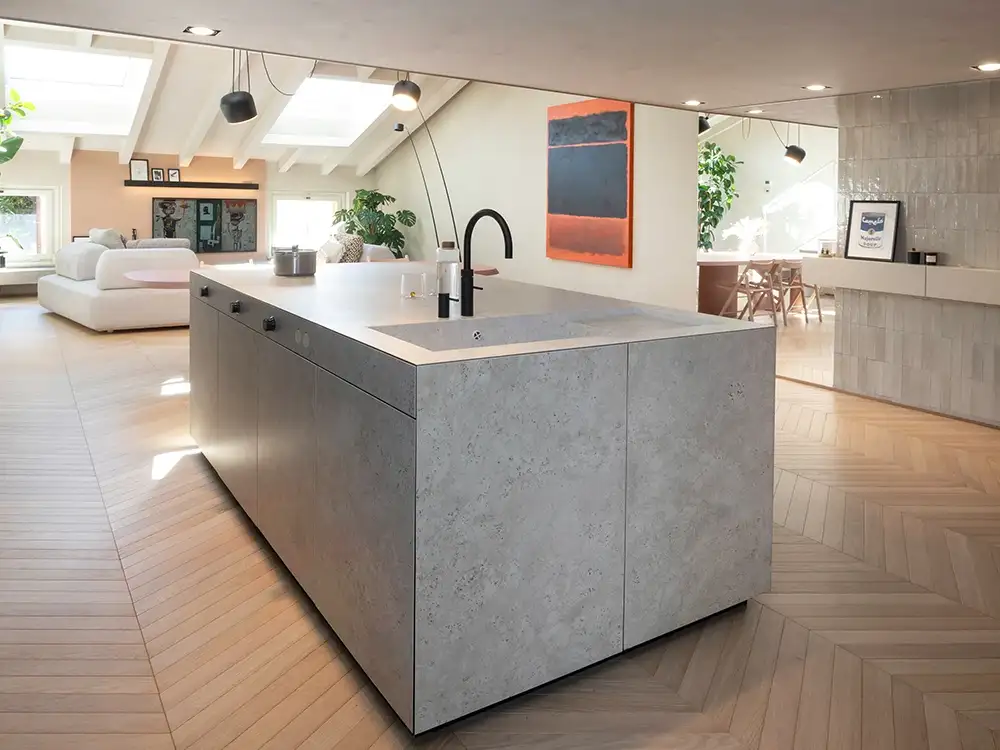
The heart of the project is represented by the kitchen island, conceived as a single continuous block in which aesthetics and functionality coexist without compromise.
Thanks to the custom processing of the Dekton® Sabbia slabs, it was possible to discreetly integrate the sink, the cooktop with Gaggenau Essential Induction technology, the storage elements and the operational surfaces.
The 45° miter joints help eliminate the perception of connections between different elements, reinforcing the effect of material continuity and enhancing the cleanliness of the lines.
The island is composed of five Dekton slabs, with thicknesses ranging from 4 to 12 mm, specifically designed to ensure aesthetic uniformity and construction precision across all visible surfaces. This configuration demonstrates how an ultracompact surface can adapt to complex processes while maintaining high quality standards.
Dekton® Sabbia integrates countertop, fronts and cooktop into a single volume
The choice of Dekton® Sabbia is driven by the desire to obtain a surface capable of combining materiality, warm tones and high technical performance.
The material fully clads the kitchen island, creating a visual continuity between countertop, fronts, sides and lateral surfaces. This solution allows the volume to be read as a single architectural element, in which every detail contributes to the coherence of the whole.
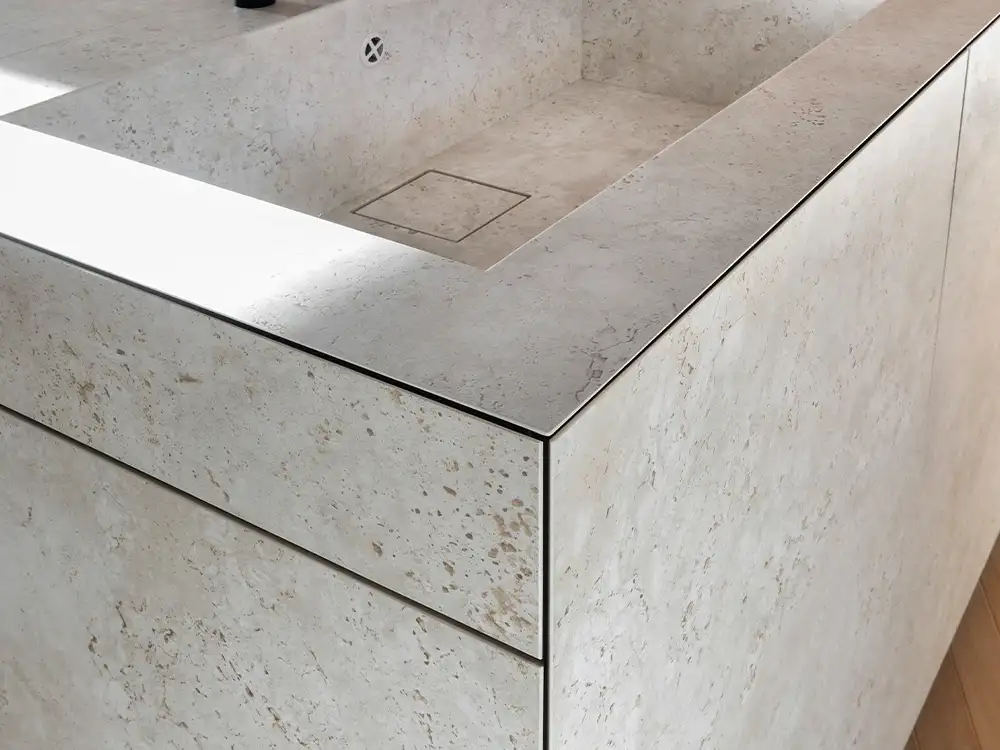
The integration of the cooktop and sink is achieved without altering the cleanliness of the composition, confirming how contemporary surface design increasingly tends to eliminate the distinction between technical surface and furniture element.
Through Dekton® Sabbia, the material thus becomes the guiding thread of the entire project, enhancing formal simplicity and the high execution quality of the kitchen.
Dekton® technical performance enhance the kitchen project
Beyond the aesthetic impact, the project demonstrates how an ultracompact surface can meet the demands of an environment subject to intensive daily use.
The technical characteristics of Dekton® indeed allow the realization of complex design solutions without compromising reliability and long-term durability. The surface offers high scratch resistance, resistance to abrasion, impact, heat and thermal shock, qualities that make it particularly suitable for producing kitchen countertops, working islands and work surfaces.
Added to these performances is an extremely low liquid absorption, which facilitates daily cleaning and maintenance operations, helping to keep the surface appearance unchanged even after years of use.
Thanks to these characteristics, Dekton® allows designers to develop kitchens with strong architectural impact without sacrificing the performances required by one of the most heavily used areas of the home.
45° joints and custom workmanship reinforce material continuity
One of the most interesting aspects of the project concerns the precision of the workmanship carried out on the Dekton® slabs.
The 45° miter joints make it possible to eliminate the perception of connections between the different surfaces, contributing to building a continuous volume in which countertop, sides and fronts interact without visual interruptions.
The ability to produce custom elements with different thicknesses while maintaining perfect aesthetic continuity significantly expands the design opportunities offered by the ultracompact surface.
This approach allows the creation of kitchens characterized by strong formal clarity, in which the material becomes the main compositional element and helps define the overall perception of the space.
The final effect is that of a monolithic block, capable of simultaneously expressing technical precision, material elegance and execution quality.
Dekton® Grigio extends the material language to living spaces
The project does not limit the use of Dekton® to the kitchen but extends the material language to the living areas as well.
For the TV unit, Dekton® Grigio, from the Pietra Kode collection, was chosen, creating a harmonious dialogue with the island made in Dekton® Sabbia.
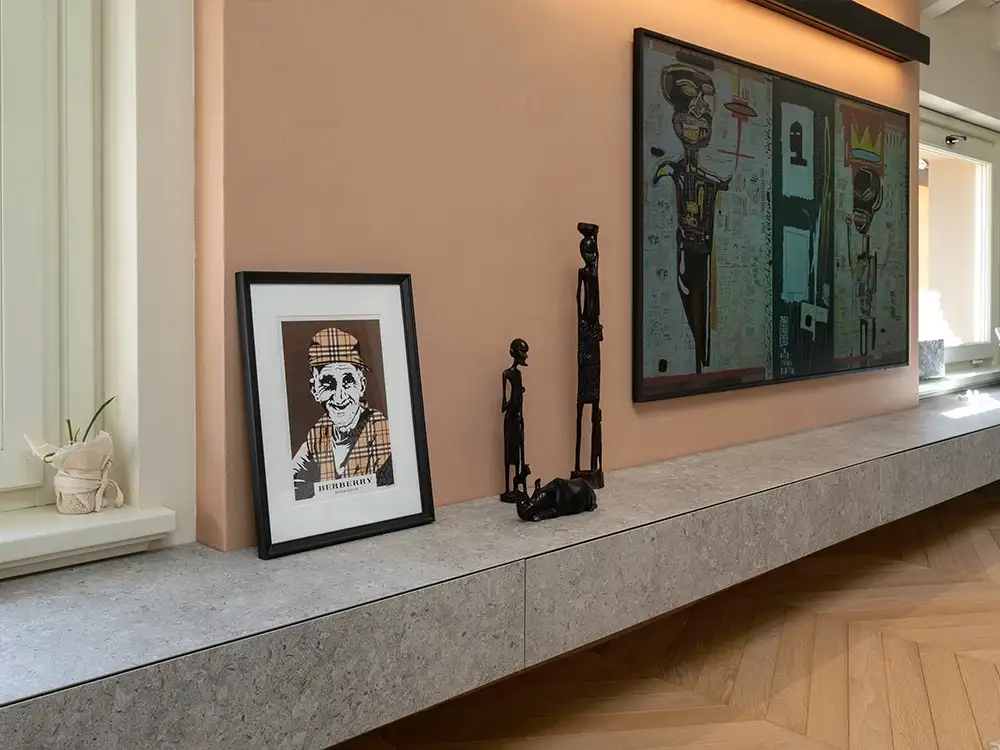
The coordinated use of two surfaces from the same collection makes it possible to maintain strong projectual continuity across the home’s spaces, reinforcing the perception of a unified area in which materials, colors and finishes interact coherently.
This solution highlights how ultracompact surfaces can be used not only for kitchen countertops but also for furniture elements and living applications, expanding the possibilities of contemporary surface design.
Dekton® expands the design possibilities of contemporary surface design
The case study developed by Valentina Ferro together with LOOV Design represents a concrete example of the potential offered by Dekton® Pietra Kode in interior design.
The combination of material continuity, technical performance, custom workmanship and aesthetic quality demonstrates how an ultracompact surface can become a true architectural material, capable of contributing to the identity of the entire project.
From the kitchen island to the TV unit, every element arises from the desire to build a coherent language in which the surface not only serves as cladding but actively participates in defining volumes and space.
Through this project, Cosentino confirms the versatility of Dekton® as a solution dedicated to architects, interior designers and planners seeking materials able to combine design, innovation and high performance.
The result is an environment in which surface design becomes the protagonist, transforming the kitchen into a monolithic element capable of integrating technology, functionality and material research into a single design solution.
FAQ What is Dekton® Pietra Kode?
Dekton® Pietra Kode is a collection of ultracompact surfaces developed by Cosentino, designed for interior design and architectural applications. It combines high technical performance with an aesthetic inspired by natural stone, allowing the realization of kitchen countertops, furnishings and continuous surfaces.
Why is Dekton® suitable for kitchen countertops?
Thanks to its high scratch resistance, resistance to impact, heat, thermal shock and its extremely low liquid absorption, Dekton® is an ideal solution for kitchen countertops and surfaces subjected to intensive daily use.
What applications were realized in the project?
The case study includes a monolithic kitchen island, the fronts, the countertop, the integrated sink, the Essential Induction cooktop and a coordinated TV unit, using Dekton® Sabbia and Dekton® Grigio from the Pietra Kode collection.
What advantages does an ultracompact surface offer?
An ultracompact surface provides high durability, ease of maintenance, material continuity, precision in workmanship and wide design freedom, maintaining its aesthetic and technical characteristics over time.
Who designed the kitchen?
The project was developed by architect Valentina Ferro, in collaboration with LOOV Design, with the goal of creating a monolithic kitchen in which surface, functionality and technology coexist in a single continuous volume.