 en
en  Italian

- 31/08/2026
- Technological materials
Index
-
Article description
- Floem De Castelli: a metal cladding inspired by the lotus flower
- A 3D decorative wall that changes with the composition
- Copper and brass claddings: Floem finishes
- Wall claddings for interiors: when the surface becomes three-dimensional
- From metal cladding to wall art
- Metallic claddings in contemporary surface design
- Floem technical sheet
- FAQ on 3D metallic claddings
- Fill the contact form
How can a rigid material like metal convey the lightness and movement of a petal?
3D metallic claddings are expanding the design possibilities of vertical surfaces through processes that introduce relief, depth and variations in light reflection. The wall is no longer interpreted solely as a plane to be covered, but can become a three-dimensional element that directly contributes to the definition of the space.
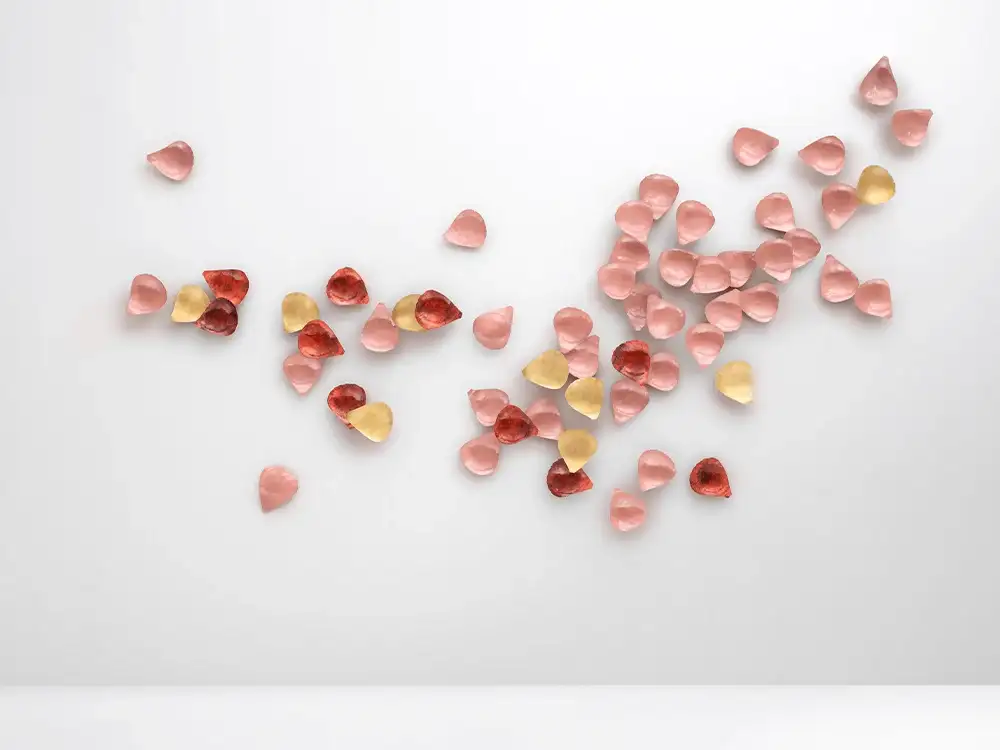
It is in this context that Floem by De Castelli fits, a decorative cladding made up of metal elements inspired by lotus flower petals.
Copper, brass, curves and different tilts transform the surface into a dynamic composition, where perception changes depending on the arrangement of the elements, the viewing point and the light.
Floem De Castelli: a metal cladding inspired by the lotus flower
The name Floem comes from the meeting of the English words flower and poem, anticipating the poetic component at the heart of the project.
The inspiration comes from the lyrical universe of Li Qingzhao, a Chinese poet of the Song dynasty, and from the image of the lotus flower, an element with strong symbolic value in Eastern culture.
The project transfers the lightness of the petal into a material apparently opposite like metal.
The individual three-dimensional elements are arranged on the wall to create a sort of suspended bloom: curves, tilts and varying reflections visually lighten the material and introduce a sense of movement.
The contrast between the rigidity of metal and the delicacy of organic forms thus becomes one of the central elements of the project.
A 3D decorative wall that changes with the composition
Floem is not conceived as a fixed pattern.
One of the most interesting aspects of the project is indeed the possibility to freely compose the metal elements on the wall, changing position, orientation, density and the relationship between individual petals.
The surface can therefore take on different configurations depending on the space and the desired design outcome.
The idea stems from observing the behavior of real petals. During the project development, the designers let some petals float in the air, observing their movement, collisions and the natural way they settled.
The principle is transferred to the cladding: starting from a common element, each configuration changes through variations of angle, relief, tone and reflection.
Three-dimensionality therefore does not perform a purely decorative function, but becomes part of the wall's compositional system.
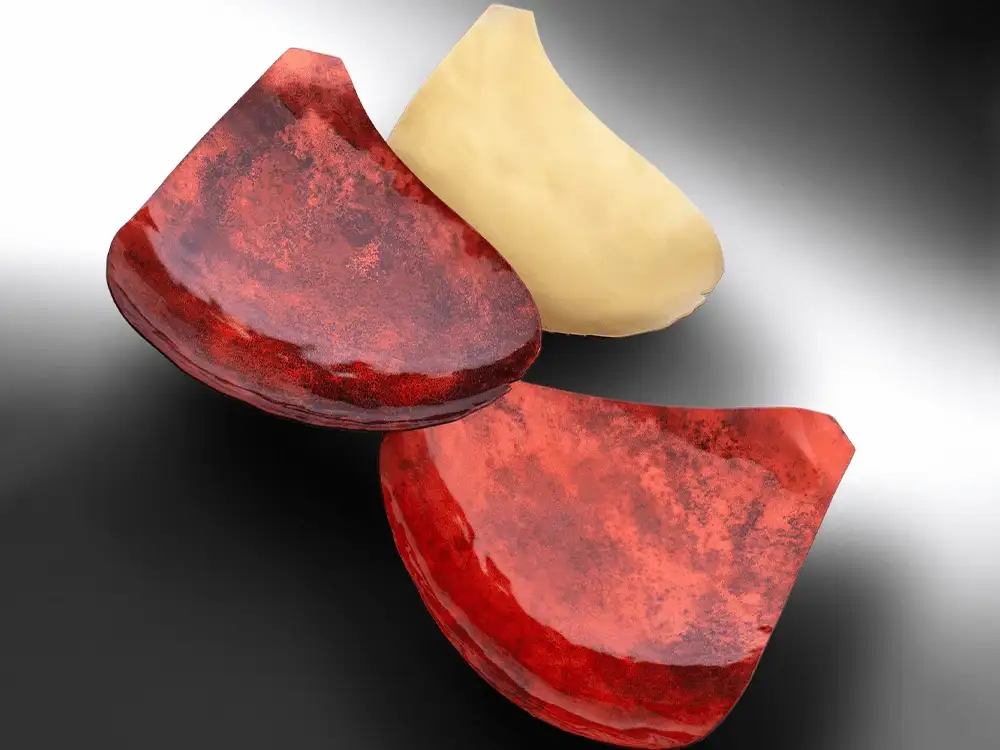
Copper and brass claddings: Floem finishes
The material component of Floem is born from the combination of copper and brass, two metals used in interior design also for their ability to interact with light.
The project pairs the DeNuance finish applied to copper with brass in the DeLabré finish.
The warm tones of the two materials combine with the three-dimensional geometry of the elements: curves and tilts generate different reflections, bringing out or softening parts of the composition depending on the lighting and the viewing point.
It is precisely this relationship between metal, light and depth that distinguishes three-dimensional metallic claddings from a completely flat surface.
Light thus becomes a variable component of the project, capable of changing the perception of the wall during the day.
Wall claddings for interiors: when the surface becomes three-dimensional
The evolution of interior wall claddings is progressively expanding the role of surfaces in design.
Texture, tactile finishes, large formats, reliefs and three-dimensional modules allow the wall to go beyond a mere finishing function to become one of the defining elements of interior design.
In the case of Floem, depth is achieved through elements physically separated from the wall plane.
The result generates shadows, chromatic variations and reflections that change depending on the lighting.
This approach makes the cladding particularly interesting in projects where the vertical surface must play a recognizable visual role, for example in residential spaces, hospitality, retail and contract environments.
From metal cladding to wall art
Floem also introduces a reflection on the boundary between decorative cladding and wall art.
When the elements composing a surface can be freely organized and their arrangement directly contributes to the aesthetic result, the wall becomes an active part of the composition.
The cladding is therefore not perceived exclusively as a material applied to the architecture, but as a decorative system capable of dialoguing with the space.
With Floem, this relationship is built through a few fundamental elements: metal, form, light, shadow and composition.
The possibility of intervening on the arrangement of individual petals also makes it possible to adapt the design to the proportions and characteristics of the wall.
Metallic claddings in contemporary surface design
Copper, brass, steel and other metals are used in surface design to work simultaneously on color, texture, reflection and depth.
Working and finishing techniques also allow the perception of materials traditionally associated with rigidity to be transformed, introducing softer, more organic or irregular effects.
De Castelli's research has long been part of this field, exploring metal as a material for surfaces, claddings and elements intended for architecture and interior design.
Floem continues this research focusing on the visual lightness of the material.
The three-dimensionality of the petals and the possibility of creating different configurations thus show one of the possible directions for contemporary 3D metallic claddings: not simply surfaces to be applied to the wall, but systems through which to design material, light and space.
Floem technical sheet
| Feature | Floem |
|---|---|
| Product | Floem |
| Brand | De Castelli |
| Type | Three-dimensional metal cladding / decoration |
| Materials | Copper and brass |
| Finishes | DeNuance on copper, DeLabré on brass |
| Inspiration | Lotus flower petals |
| Configuration | Composable |
| Visual characteristics | Reliefs, curves, shadows and reflections |
| Application | Walls and interior design |
| Project year | 2025 |
FAQ on 3D metallic claddings
This time I would deliberately set the FAQ with 3 generic questions + 2 dedicated to Floem. It is much more consistent with the SEO strategy we have chosen.
What are 3D metallic claddings?
3D metallic claddings are surfaces characterized by elements, processes or geometries in relief that introduce depth relative to the wall plane. Three-dimensionality allows the creation of different shadows and reflections depending on the lighting and the viewing point.
Which metals are used for wall claddings?
Materials used for metallic claddings can include copper, brass, steel and other metals or alloys, chosen and worked according to the aesthetics, finish and characteristics required by the project.
Where to use metallic claddings for interiors?
Metallic claddings can be used to characterize walls and surfaces in different interior design contexts, from residential spaces to contract, hospitality and retail environments. The choice must be evaluated in relation to the material, finish and the specific application’s characteristics.
What is Floem by De Castelli?
Floem is a three-dimensional decorative metal cladding by De Castelli, inspired by lotus flower petals. It is composed of copper and brass elements that can be arranged on the wall in different configurations.
Which finishes are used for Floem?
Floem combines the DeNuance finish on copper with brass in the DeLabré finish. The three-dimensionality of the elements allows the metal finishes to generate different reflections depending on the light and their inclination.