 en
en  Italian

- 24/09/2026
- Technological materials
Index
-
Article description
- Artik Nodes: the new Dekton collection from Cosentino
- Borealis: ivory-white Dekton surface with sand-colored veining
- Kobuk: taupe Dekton with light veining
- Nordal: pearl gray surface with coppery veining
- Dekton for countertops, floors and claddings
- Dekton surfaces for interiors and exteriors
- Resistance to UV, heat, scratches, stains and thermal shock
- Dekton Artik Nodes thicknesses: 0.8, 1.2 and 2 cm
- Textured surfaces and continuity between indoor and outdoor
- Cosentino expands the Dekton portfolio with Artik Nodes
- FAQ on Dekton surfaces and Artik Nodes
- Fill the contact form
The ultracompact surfaces offer different application possibilities in architecture and interior design, from countertops to floors and claddings as well as outdoor spaces.
Within this context sits Artik Nodes, the new Dekton ultracompact surfaces collection from Cosentino, inspired by Arctic landscapes and available in three variants: Borealis, Kobuk and Nordal.
The collection combines aesthetic research and technical characteristics through surfaces characterized by mineral veining, varying graphic depth and tones that evoke the meeting of ice and rock.
Artik Nodes is available in thicknesses of 0.8, 1.2 and 2 cm and is designed for various indoor and outdoor applications, including countertops, floors and claddings in residential and commercial projects.
Artik Nodes: the new Dekton collection from Cosentino
The concept of Artik Nodes starts from observing Arctic landscapes, where ice and rock formations create an irregular geography of lines, stratifications and intersections.
It is precisely these meeting points, the “nodes” referenced by the collection's name, that become the reference for developing the new patterns.
Through Dekton technology, Cosentino translates these natural inspirations into surfaces that alternate areas of greater graphic intensity with more uniform zones.
Color, texture and finish thus give rise to different interpretations of the material: from brighter surfaces with marked visual depth to solutions with a more natural, tactile appearance.
Borealis, Kobuk and Nordal are the three surfaces of Cosentino’s Dekton Artik Nodes collection and are distinguished by tone, veining and graphic depth.
Borealis: ivory-white Dekton surface with sand-colored veining
Borealis represents the lightest interpretation of the Artik Nodes collection.
The surface features an ivory-white base, accompanied by a delicate pinkish hue and crossed by irregular sand-colored veining.
The contrast between base and veining remains balanced, allowing the pattern to structure the surface without overpowering the base tone.
The result is a predominantly light, mineral aesthetic with cool undertones, where pattern variations contribute to the perception of depth.
Borealis can therefore be used in projects seeking a light veined surface, maintaining a material language inspired by the natural world.
Kobuk: taupe Dekton with light veining
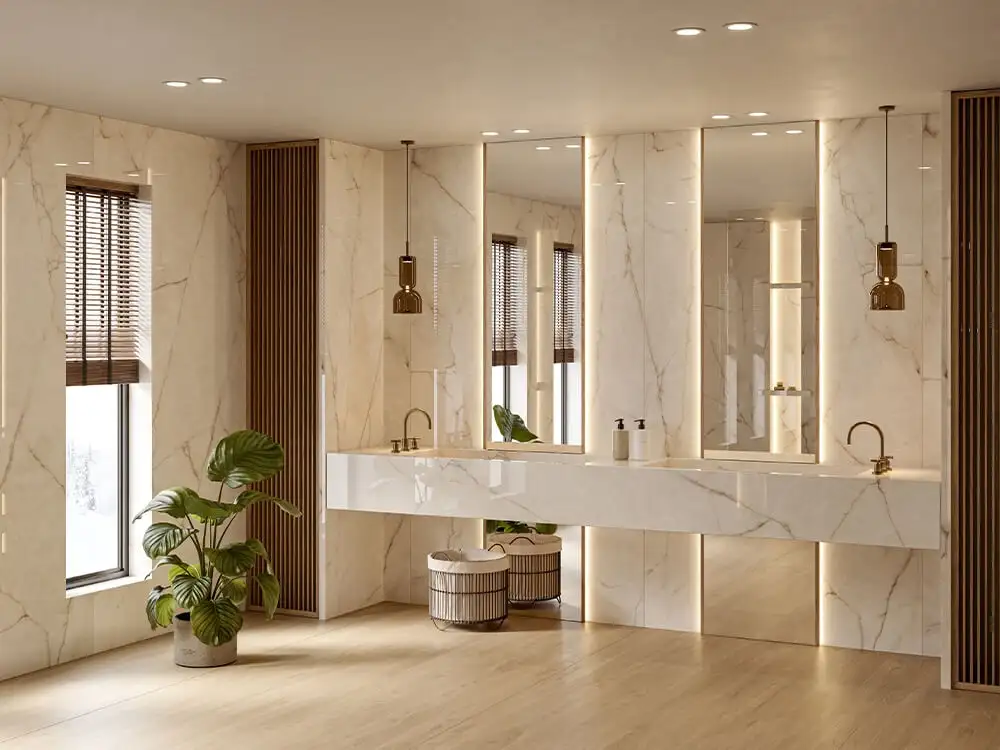
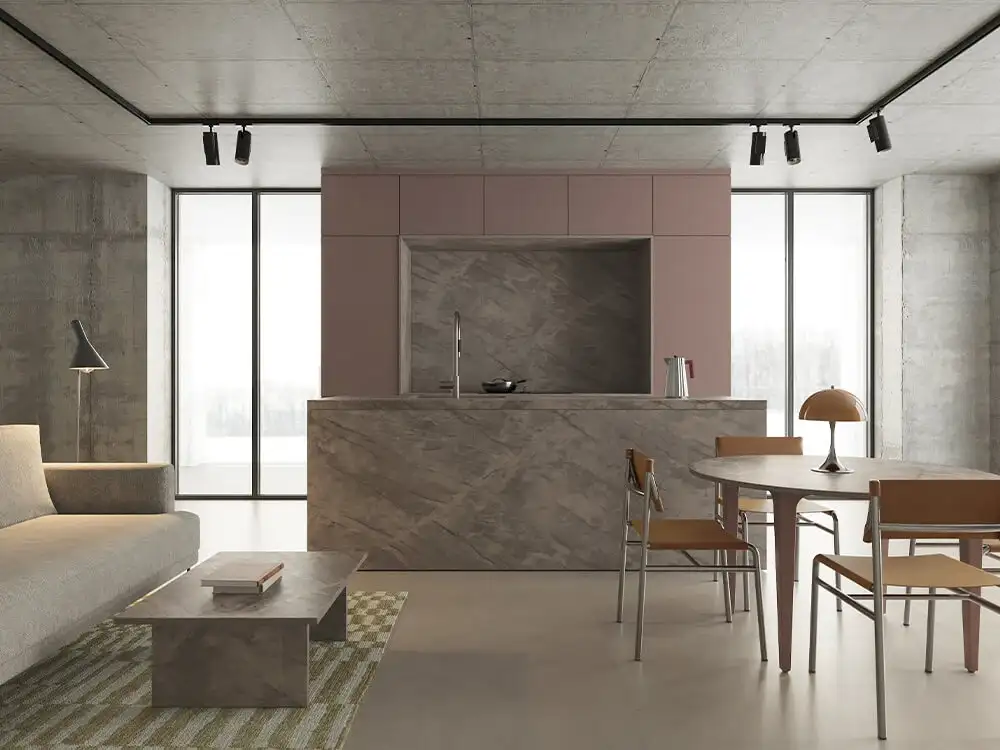
With Kobuk, the collection moves toward a more intense palette.
The surface is characterized by a deep, enveloping taupe, crossed by thin light veins that intersect across the background.
Compared to the brightness of Borealis, Kobuk introduces greater chromatic density and an overall warmer tone.
The pattern maintains the intersection principle that characterizes Artik Nodes, but the greater contrast between base and veining results in a more pronounced visual presence.
The surface can interact with different materials and finishes, offering a solution for projects where the countertop or cladding takes on a more noticeable color role.
Nordal: pearl gray surface with coppery veining
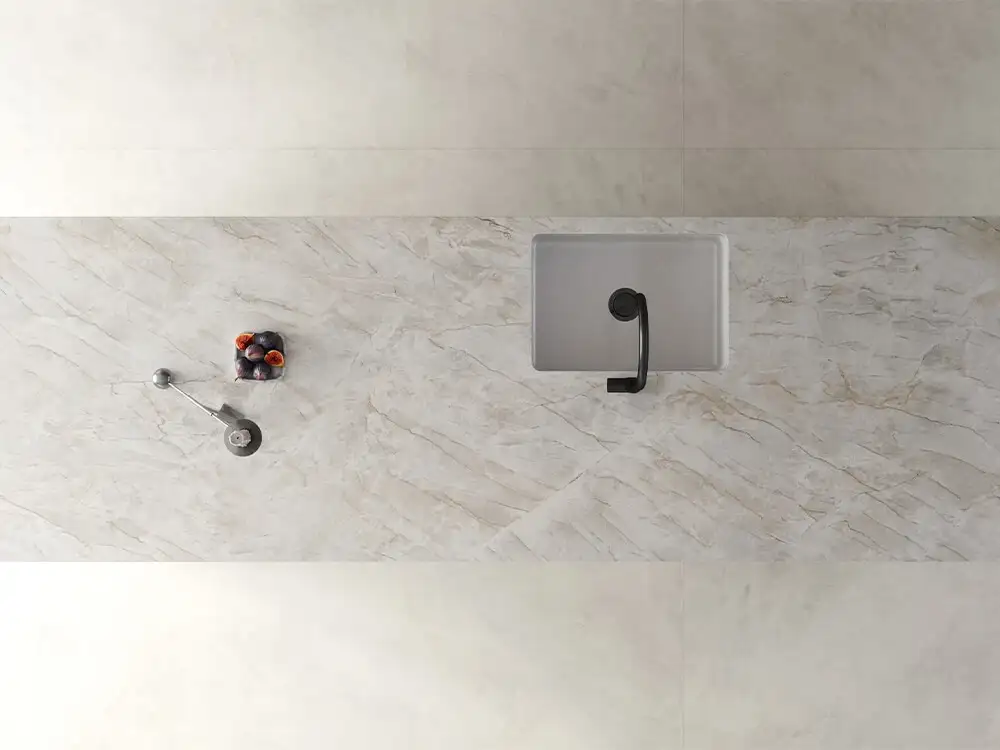
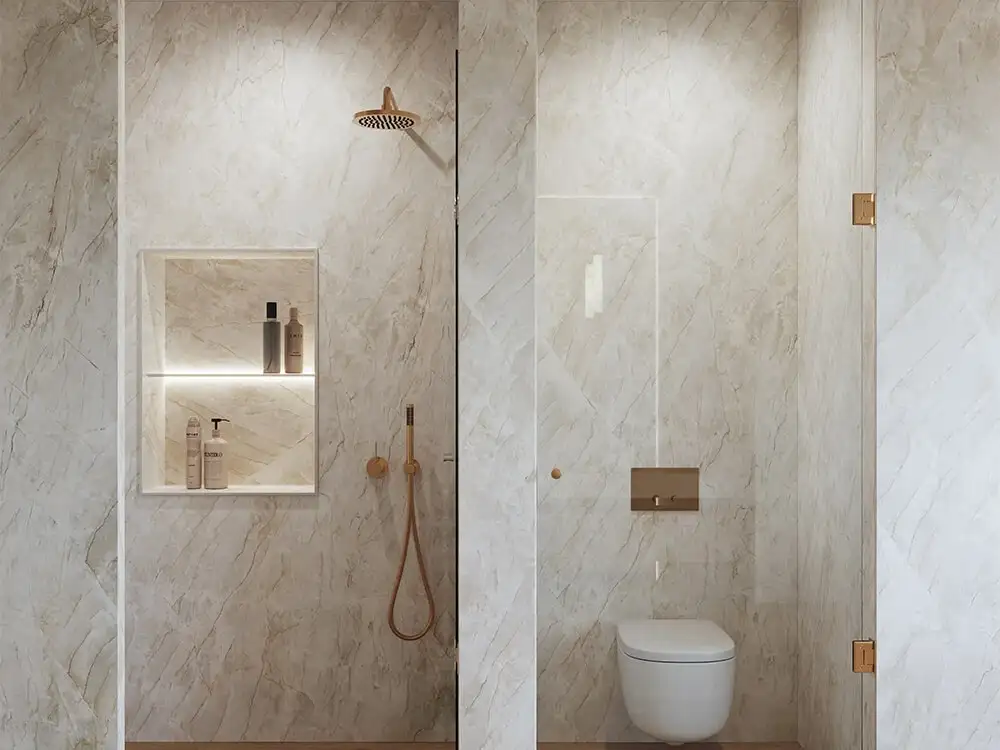
Nordal instead uses a very light pearl gray base, on which thin diagonal veins with warm coppery nuances develop.
The pattern alternates areas where the design becomes more concentrated with others that are almost uniform.
This variation in graphic density creates different levels of depth and visually recalls the stratifications and translucencies of ice.
The meeting of the cool background and the warmer veins also allows the surface to interact with different palettes and materials.
Borealis, Kobuk and Nordal thus build three interpretations of the same concept, ranging from ivory-white to taupe to pearl gray.
Dekton for countertops, floors and claddings
The application possibilities are one of the central elements of the Artik Nodes collection.
According to Cosentino, the surfaces can be used indoors on large areas and in different project elements, including countertops, flooring and claddings.
This versatility allows the same material language to be used at different scales, from the countertop to the architectural surface.
For example, a variant of the collection can become the focal point of a countertop or be used on larger surfaces to create greater visual continuity.
The different tones of Artik Nodes are also designed to interact with other materials and finishes, expanding combination possibilities within interior design.
Dekton surfaces for interiors and exteriors
Artik Nodes is not limited to indoor applications.
The collection can also be used for outdoor applications, in both residential and commercial projects, according to Cosentino's technical specifications for Dekton.
The ability to use the same family of surfaces indoors and outdoors allows work on the material continuity between indoor and outdoor spaces, a theme increasingly present in contemporary design.
Colors, veining and finishes can thus become connecting elements between different environments, maintaining a visual relationship between the project's various areas.
Resistance to UV, heat, scratches, stains and thermal shock
Aesthetic characteristics are paired with the technical performance of the Dekton ultracompact surface.
According to Cosentino, Artik Nodes offers high resistance to UV rays, fire and heat, scratches, stains and thermal shock, as well as virtually zero porosity.
UV resistance is particularly relevant for outdoor applications, where the surface is directly exposed to sunlight.
Resistance to stains, scratches and heat is instead an important characteristic for frequently used applications, such as countertops.
The technical performance thus broadens the contexts in which the three Artik Nodes variants can be integrated into architectural and interior design projects.
Dekton Artik Nodes thicknesses: 0.8, 1.2 and 2 cm
The Dekton Artik Nodes collection is available in thicknesses of 0.8, 1.2 and 2 cm.
The availability of three thicknesses makes it possible to select the most suitable configuration based on the application and specific design requirements, in compliance with the manufacturer's technical guidelines.
Varying the thickness also allows working with the material at different scales, from claddings and floors to countertops.
In this way, color and pattern can be maintained within the same design language while meeting different application needs.
Textured surfaces and continuity between indoor and outdoor
One of the interesting aspects of Artik Nodes is the possibility of combining the collection's mineral aesthetic with different materials present in the project.
The collection's tones have been developed to interact with other colors and finishes, allowing pairings with woods, metals and other surfaces used in interior design and architecture.
Borealis offers a clear and luminous base, Kobuk introduces a deeper, warmer tone, while Nordal works on the contrast between pearl gray and coppery nuances.
The three variants therefore allow changing the project's character while maintaining a common aesthetic origin linked to the interpretation of the Arctic mineral landscape.
Cosentino expands the Dekton portfolio with Artik Nodes
With Artik Nodes, Cosentino expands the Dekton portfolio through a collection that relates natural inspiration, graphic depth, color and technical performance.
The Arctic landscape becomes the starting point for three different interpretations: Borealis, with its ivory-white base; Kobuk, characterized by an intense taupe; and Nordal, with a pearl gray background and coppery-toned veining.
Availability in three thicknesses and the possibility of use for countertops, floors, claddings and outdoor applications allow the collection to be applied in different areas of residential and commercial design.
Artik Nodes thus expands Dekton's aesthetic possibilities through surfaces that combine a mineral language with the technical characteristics of the technology developed by Cosentino.
FAQ on Dekton surfaces and Artik Nodes
What is Dekton?
Dekton is an ultracompact surface developed by Cosentino for various applications in architecture and design. The portfolio includes solutions usable in different indoor and outdoor contexts, according to the technical specifications indicated by the manufacturer.
What is Cosentino's Artik Nodes?
Artik Nodes is a collection of Dekton ultracompact surfaces by Cosentino inspired by Arctic landscapes and the geometries generated by the meeting of ice and rock. The collection includes Borealis, Kobuk and Nordal.
What colors does Dekton Artik Nodes include?
The collection includes three variants: Borealis, ivory-white with pinkish hues and sand-colored veining; Kobuk, intense taupe with thin light veins; Nordal, pearl gray with coppery-toned veining.
What is the difference between Borealis, Kobuk and Nordal?
The three surfaces share the mineral inspiration of Artik Nodes but differ in palette and pattern. Borealis is predominantly ivory-white, Kobuk uses an intense taupe and Nordal features a very light pearl gray base.
What are the thicknesses of Dekton Artik Nodes?
Artik Nodes is available in thicknesses of 0.8 cm, 1.2 cm and 2 cm.
Where can Dekton Artik Nodes be used?
According to Cosentino, Artik Nodes can be used for countertops, flooring and claddings, as well as for outdoor applications in residential and commercial projects.
Can Dekton Artik Nodes be used outdoors?
Yes. Cosentino envisions the collection's use for outdoor applications and states, among the surface's characteristics, high resistance to UV rays and thermal shock.
What are the technical characteristics of Dekton Artik Nodes?
According to Cosentino, Artik Nodes features high resistance to UV rays, fire and heat, scratches, stains and thermal shock, along with virtually zero porosity.