 en
 Italian


Index
-
Article description
- Natural stone slabs: a space dedicated to material selection
- Marble and natural stone in bookmatch: continuity of the veining
- Stone processing and finishes: the Textures+ Collection
- Backlit natural stone: veining, depth and translucency
- Claddings and furniture in natural stone: applications in the Stone Gallery London
- Marbles, quartzites and natural surfaces: materials of the Antolini® project
- Alessandro La Spada: light in the design of natural surfaces
- Antolini®: 70 years of research on natural stone
- Fill the contact form
How do you choose the most suitable natural stone for an interior design project? Veining, color variations, surface finishes, fabrication processes and interaction with light are some of the elements that help define its expressive and applicative possibilities.
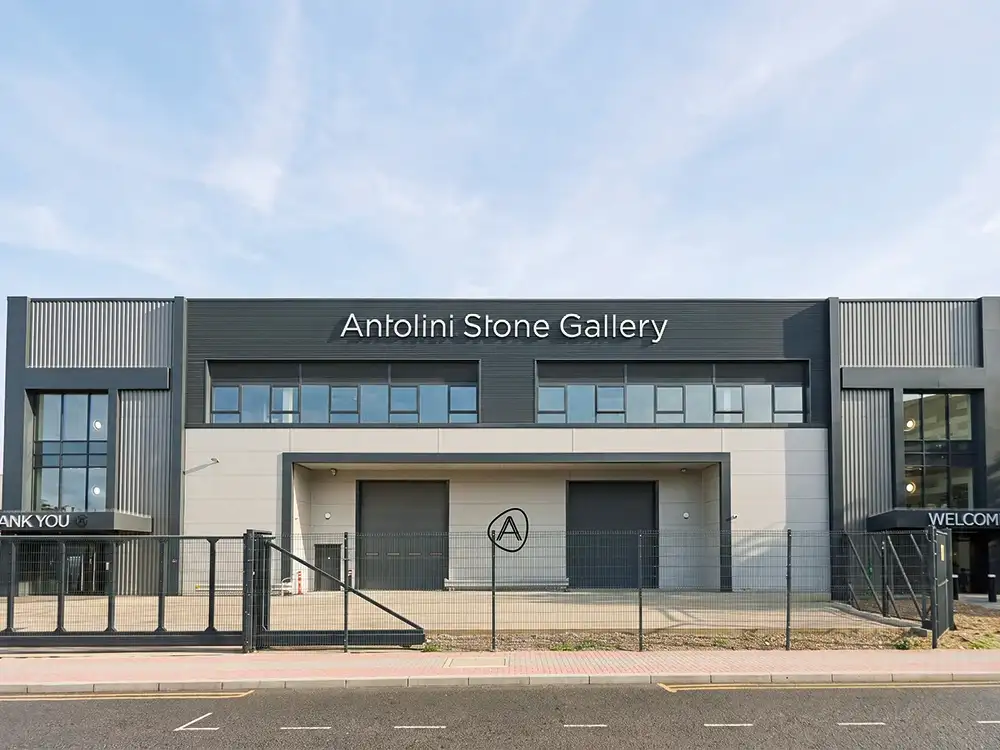
These aspects are the focus of the Antolini® Stone Gallery London, the new exhibition space inaugurated on October 22, 2026 at number 35 Pensbury Place, in the London neighborhood of Nine Elms.
Designed by Creative Lead Alessandro La Spada and spread over two levels, the Gallery presents a selection of the Italian company's more than 1,300 catalogued natural stones, through a route that relates materials, processing technologies and applications in contemporary architecture.
Natural stone slabs: a space dedicated to material selection
The selection of natural stone represents a significant phase in interior design. Unlike surfaces characterized by repeatable graphics, each natural stone slab shows variations related to its geological formation.
Direct observation makes it possible to assess the distribution of veins, color shades and the aesthetic characteristics of individual slabs, identifying the solutions most consistent with the project. Antolini® Stone Gallery London was conceived as a place for research and comparison, where architects, interior designers and clients can examine materials from the earliest design phases.
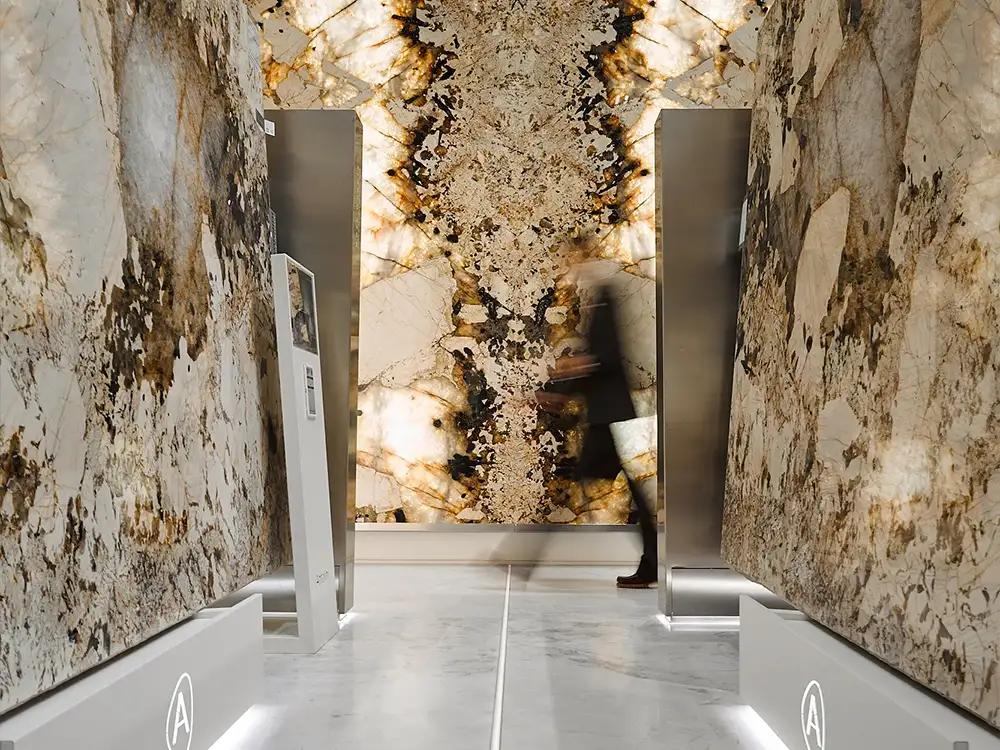
On the ground floor, the slabs are displayed on trestles within an exhibition route that allows comparison of different types of stone, color combinations and surface treatments. The installation, inspired by art exhibition spaces, uses light to enhance the distinctive characteristics of the materials.
Marble and natural stone in bookmatch: continuity of the veining
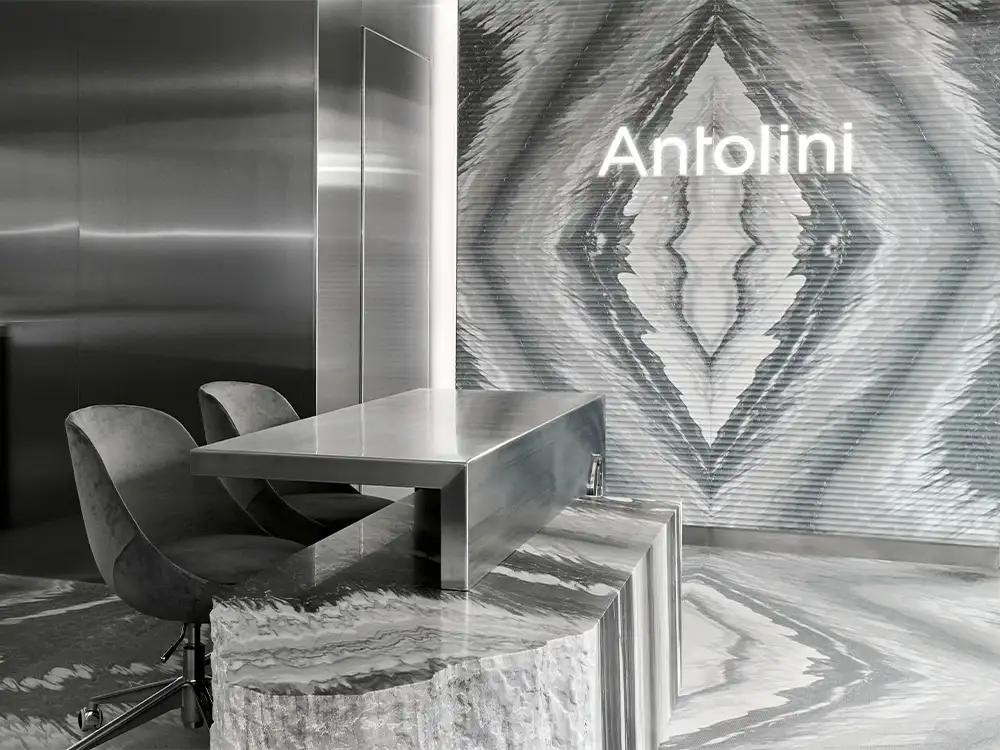
Among the solutions presented in the Gallery is the arrangement of slabs in macchia aperta, also known as bookmatch. This compositional technique involves the mirror-like pairing of appropriately selected and finished slabs, creating visual continuity between the veins and producing symmetrical patterns.
Bookmatching is used in the design of marble claddings and other natural stones, particularly when the surface is intended to play a defining role within the environment. The selection of slabs, the direction of the veins and the design of the joints are crucial in determining the final aesthetic result.
In the London Stone Gallery, bookmatched compositions interact with surfaces characterized by different textures, highlighting how the same material can take on different expressions depending on the finishing process.
Stone processing and finishes: the Textures+ Collection
Surface processing is one of the tools through which the designer can modify the perception of natural stone. A surface can assume different visual and tactile characteristics depending on its structure, the depth of the reliefs and the way it reflects light.
With the Textures+ Collection, Antolini® offers around fifty finishes that interpret the material through original patterns and textures. The collection, present in the Stone Gallery London, allows observation of the relationship between the stone's natural pattern and the transformation of the surface.
For interior design, the ability to compare different finishes of the same material expands coordination opportunities between claddings, flooring and furniture elements. Texture thus becomes a design component to evaluate together with color, geometry and the intended use of the surface.
Backlit natural stone: veining, depth and translucency
Light is one of the central elements of Alessandro La Spada's project. In addition to enhancing exposed surfaces, it is integrated directly into some natural stone applications through backlighting.
In the Stone Gallery London this solution is used on the kitchen wall in Irish Green® and on the bathroom cladding in Cristallo Vitrum®. Backlighting highlights the veins, depth and translucency of the materials, changing their perception compared to traditional frontal illumination.
However, not all natural stones have the same light transmission characteristics. Designing a backlit surface therefore requires a specific evaluation of the material, slab thickness, the support system and the light source. The integration of stone and light opens further expressive possibilities in the design of walls, bathroom claddings, decorative elements and furniture surfaces.
Claddings and furniture in natural stone: applications in the Stone Gallery London
The Gallery does not limit itself to displaying materials but integrates them directly into the architecture of the spaces. On the ground floor, the reception area is organized into two volumes, in which natural stone is used for floors, vertical claddings and furnishings.
The entry volume is characterized by Cipollino GreyWave, while the volume dedicated to the exit develops its material language around Irish Green®. On the first floor, Bianco Lasa | Covelano Vena Oro and Quarzite Madeirus define the areas intended for work, meetings and relational activities.
Natural stone is also applied to the long table in the central area, to drawer units, to office walls, to the kitchen and to the bar. These applications make it possible to observe the material not only as a single slab but in relation to volumes, proportions, light and other elements of the furnishings.
Marbles, quartzites and natural surfaces: materials of the Antolini® project
The selection of materials used in the Gallery highlights different application possibilities of natural stone.
| Material | Application in the project |
|---|---|
| Cipollino GreyWave | Entrance volume |
| Irish Green® | Exit volume and backlit kitchen wall |
| Cristallo Vitrum® | Backlit bathroom cladding |
| Bianco Lasa | Covelano Vena Oro | First-floor table, drawer units and kitchen |
| Quarzite Madeirus | First-floor bar and spaces |
The integration of the stones into the exhibition and operational spaces allows a deeper exploration of the relationship between material, processing and function.
The choice of a stone for claddings, floors or furniture surfaces must nevertheless consider, in addition to aesthetic characteristics, the technical properties of the material and the expected conditions of use specified by the project.
Alessandro La Spada: light in the design of natural surfaces
The concept developed by Alessandro La Spada is based on an intentionally essential architecture, characterized by neutral tones and light surfaces, designed to leave natural stone the leading role. Light takes on a compositional function, guiding the visitor in the observation of veins, textures and translucencies.
The alternation between matte surfaces, glass partitions and stony materials helps build a route in which the perception of the stone changes according to viewing conditions and applications.
The space thus becomes a tool to deepen the design possibilities of natural materials.
Antolini®: 70 years of research on natural stone
The opening of the Stone Gallery London coincides with Antolini®'s 70th anniversary, a company founded in Verona in 1956 by Luigi Antolini. According to company data, the catalogue today includes more than 1,300 natural stones, of which over 90 are exclusive, selected from quarries in different geographical areas.
The company reports a daily production of 4,500 square meters of slabs and a commercial presence in 182 countries. With its first Stone Gallery abroad, Antolini® develops a new meeting place between material research and design culture, where natural stone can be explored through finishes, fabrication processes and concrete applications in architecture and interior design.