 en
en  Italian

- 21/10/2026
- Natural stone surfaces
Index
-
Article description
- Waterjet cutting of marble: from precision to experimentation
- Versilys marble: natural veining and stone processing
- Wabi Sabi philosophy and design: imperfection as an aesthetic value
- Sculptural marble side tables: the relationship between material and form
- Marmo Arredo: research and technologies for natural stone processing
- EDIT Napoli 2026: emerging design meets marble processing
- Fill the contact form
To transform imperfection into a design element, exploring the relationship between technology and the stone's natural behavior. This is the principle behind Wabi Sabi, the designer marble side table made by Marmo Arredo in collaboration with designer Laura Cabbia, founder of LRA.form.
The project was presented at EDIT Napoli 2026, from October 9 to 11 at the Complesso de La Santissima, as part of the initiative dedicated to emerging designers under 30. Wabi Sabi was born from experimentation in the processing of marble with waterjet technology, used unconventionally to achieve deliberately irregular surfaces and profiles.
The result is a furnishing piece with a sculptural presence, in which the material's natural characteristics and the effects of the production process help define the object's identity.
Waterjet cutting of marble: from precision to experimentation
At the heart of the Wabi Sabi project is the experimental use of the waterjet cutting, a technology that employs a jet of ultra-high-pressure water for material processing. Generally associated with precision cutting, in this case the process is applied to a significant thickness of marble to obtain a result different from what is normally sought in stoneworking.
The action of the water jet generates a natural undercut of the profile, accompanied by irregularities and fractures. These effects, which in a traditional process might be considered defects, instead become an integral part of the project.
The processing therefore does not aim to obtain a perfectly uniform edge, but to enhance the behavior of the stone subjected to the action of the waterjet. Wabi Sabi thus explores a different interpretation of the technology applied to marble, using the characteristics of the production process as an expressive tool.
Versilys marble: natural veining and stone processing
To create the side table, Laura Cabbia chose the Versilys marble, a stone characterized by a light base crossed by delicate gray veins. The material's sober appearance highlights the transformations produced by waterjet cutting.
The natural surface of the marble dialogues with the irregular profiles, creating a contrast between the continuity of the veining and the variations produced by the processing. The choice of material therefore plays a central role in the project: not only for its aesthetic characteristics, but also for how it reacts to the transformation process. Since each marble block has different natural characteristics, the interaction with the waterjet helps make each piece different from the others.
Wabi Sabi philosophy and design: imperfection as an aesthetic value
The project's name recalls the Japanese Wabi Sabi philosophy, which recognizes an aesthetic value in imperfection, transience and uniqueness. Applied to the design of surfaces and objects, this approach invites us to consider material variations not necessarily as anomalies to eliminate, but as characteristics capable of telling the realization process.
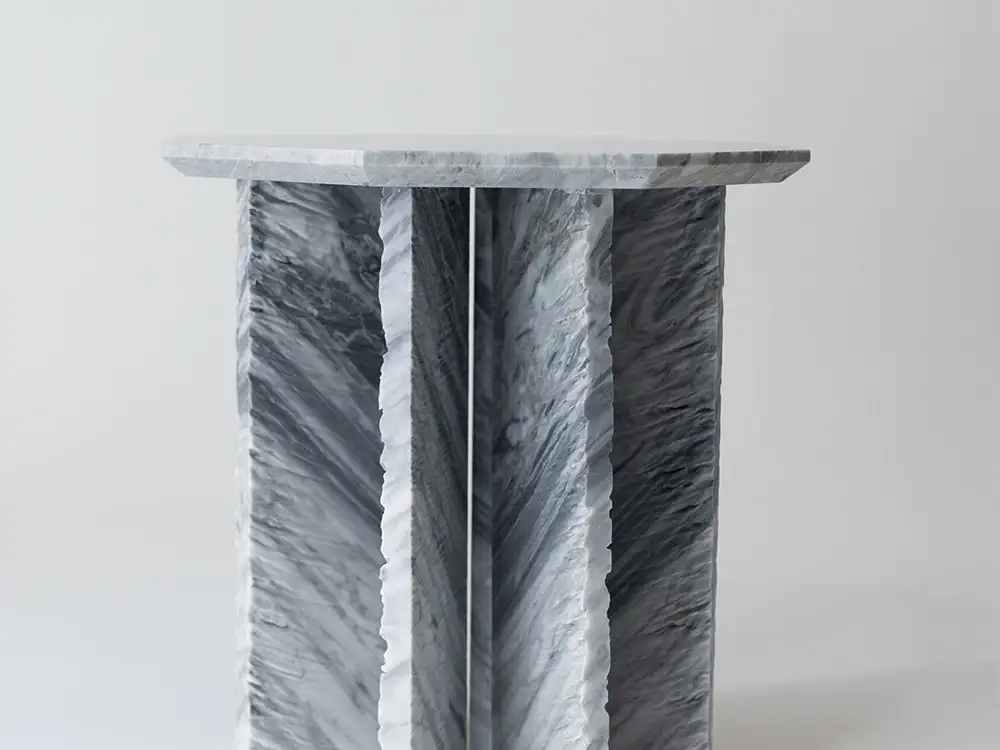
In the side table designed by Laura Cabbia, the principle takes shape through the meeting of two components: the natural variability of the marble and the unpredictability of the effects produced by processing. The irregularities thus become a distinctive element, contributing to define the object's sculptural character.
Wabi Sabi interprets marble design through research that does not hide the material's transformations, but makes them visible and recognizable.
Sculptural marble side tables: the relationship between material and form
The Wabi Sabi project fits within contemporary research on furnishing pieces in natural stone, where the material is not used only as a decorative surface but directly participates in defining the form. In the side table, the marble assumes a sculptural presence thanks to the profile variations generated by the cutting process.
The final appearance therefore arises from the dialogue between design intent and material behavior, without seeking complete uniformity of result. This experimentation highlights how stoneworking technologies can also be used to develop new formal languages in interior design.
Marmo Arredo: research and technologies for natural stone processing
The collaboration with Laura Cabbia is part of Marmo Arredo's research activity, an Italian company specialized in the processing and transformation of marbles, granites and composite materials for architecture and furnishings. Founded in 1981 in Veneto by Domenico Luigi Scapin, the company develops solutions for the interior design sector, from the production of stone kitchen countertops to the creation of custom surfaces and personalized pieces.
Production experience is accompanied by experimentation with materials and technologies, with the aim of expanding the possibilities for transforming natural stone. Marmo Arredo is part of Scapin Group, which also includes the brands Quartzforms® and Eulithe®. With Wabi Sabi, the collaboration between designer and company shows how technical knowledge of processes can contribute to the development of new expressive forms, transforming marble processing into a central component of the project.
EDIT Napoli 2026: emerging design meets marble processing
The presentation of Wabi Sabi at EDIT Napoli 2026 represents an opportunity for dialogue between design research and manufacturing skills. Laura Cabbia, founder of LRA.form, developed the project as part of the open call dedicated to emerging designers under 30, supported by Marmo Arredo in the realization phase.
The side table tells of a mode of collaboration in which the production process does not only intervene to translate a drawing into an object, but directly contributes to its definition. The Wabi Sabi experience thus opens a reflection on new possibilities for marble processing for design, showing how a precision technology can be reinterpreted to enhance the material's uniqueness.
What is Marmo Arredo's Wabi Sabi?
Wabi Sabi is a sculptural side table in Versilys marble designed by Laura Cabbia and made in collaboration with Marmo Arredo, presented at EDIT Napoli 2026.
How is waterjet technology used in the Wabi Sabi project?
The waterjet cutting is applied to a significant thickness of marble to deliberately generate undercuts, irregularities and fractures along the profile, transforming the effects of the processing into aesthetic elements.
Which marble was chosen for Wabi Sabi?
The project uses Versilys marble, characterized by a light base with delicate gray veins.
Who is the designer of the Wabi Sabi side table?
The side table was designed by Laura Cabbia, founder of the brand LRA.form, and realized with the technical and production collaboration of Marmo Arredo.
Why is the project called Wabi Sabi?
The name recalls the Japanese aesthetic philosophy that values imperfection, transience and uniqueness. In the project these principles are expressed through the stone's irregularities and the effects of waterjet cutting.